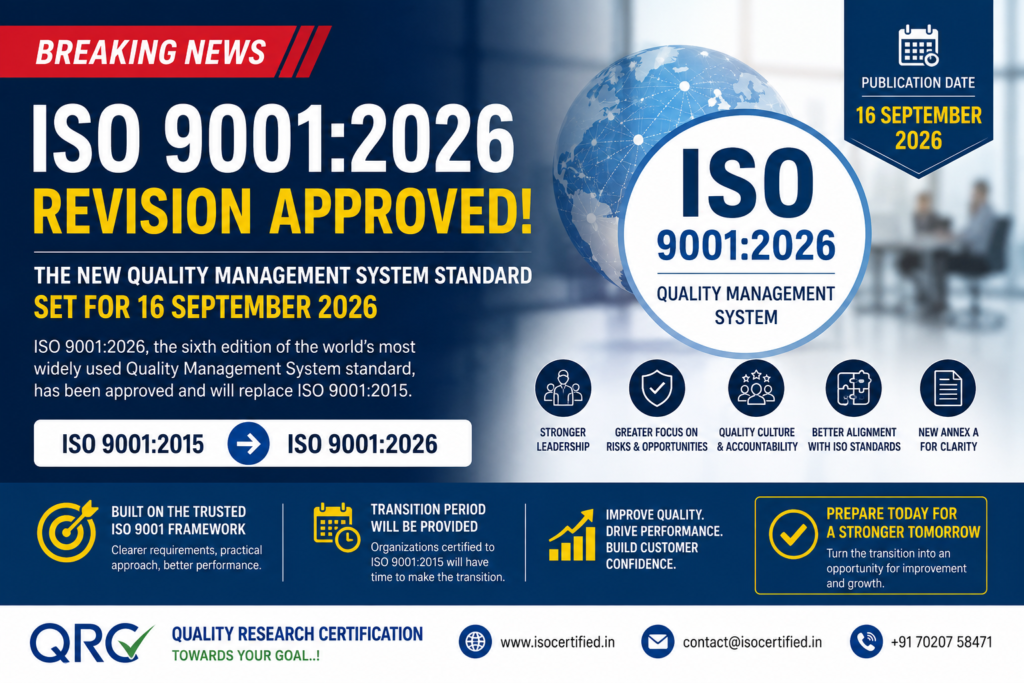


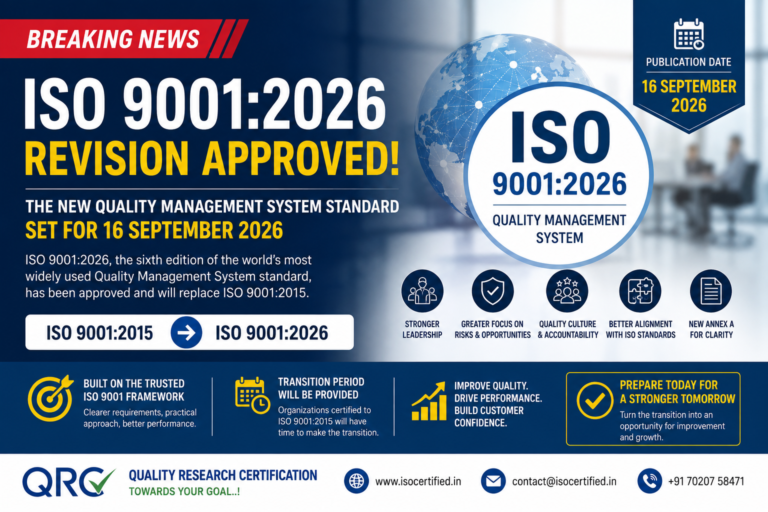

ISO 9001:2026 has reached a major milestone. The sixth edition of the world's leading Quality Management System standard has been approved and is scheduled for publication on 16 September 2026.
The revised edition is expected to replace ISO 9001:2015 and introduces targeted updates designed to improve clarity, usability and relevance for modern organizations.
ISO 9001:2026
Sixth Edition • Approved • Scheduled for publication
ISO 9001:2026 – A Major Update for Quality Management
ISO 9001 is an internationally recognized standard for Quality Management Systems. It helps organizations establish, implement, maintain and continually improve processes that support consistent quality and customer satisfaction.
The 2026 edition builds on the established ISO 9001 framework. Rather than abandoning the existing quality management approach, the revision introduces targeted updates intended to improve clarity, usability and relevance.
What Is New in ISO 9001:2026?
ISO highlights several important developments in the new edition. These updates are intended to help organizations better connect quality management with leadership, organizational culture, risk management and business performance.
Clearer Requirements
Updated wording is intended to make requirements easier to understand and apply.
Stronger Leadership
Greater emphasis is placed on leadership, quality culture and organizational accountability.
Risks & Opportunities
The revised edition provides greater clarity around managing risks and opportunities.
New Annex A
A new Annex A is intended to clarify key terms and the intent behind requirements.
Better Alignment
The standard is designed for closer alignment with other ISO management system standards.
Business Performance
Quality management continues to support performance, customer confidence and continual improvement.
ISO 9001:2026 Publication Date
16 September 2026
ISO has scheduled publication of the sixth edition for 16 September 2026.
Why Was ISO 9001 Revised?
ISO standards are periodically reviewed to ensure that they remain relevant to organizations and the environment in which they operate.
The ISO 9001 revision followed international consultation and consensus that updating the standard would help ensure that it continues to meet the evolving needs of organizations and stakeholders.
Modern organizations operate in an environment shaped by rapidly changing markets, technology, customer expectations, supply chains and business risks. ISO 9001:2026 is intended to keep quality management relevant to these realities.
ISO 9001:2015 vs ISO 9001:2026
| Area | ISO 9001:2015 | ISO 9001:2026 |
|---|---|---|
| Edition | Fifth edition | Sixth edition |
| Status | Current edition being replaced | New edition scheduled for publication |
| Framework | Quality Management System | Builds on the established QMS framework |
| Leadership | Leadership requirements | Stronger focus on leadership and quality culture |
| Risk | Risk-based thinking | Greater clarity around risks and opportunities |
| Annex | Existing supporting material | New Annex A for additional clarification |
What Does ISO 9001:2026 Mean for ISO 9001:2015 Certificate Holders?
Organizations currently certified to ISO 9001:2015 should not assume that their certificate becomes invalid immediately when the revised edition is published.
ISO has confirmed that organizations certified to ISO 9001:2015 will be granted a transition period to migrate their Quality Management System to the new edition.
This provides organizations with time to understand the revised requirements, review their existing QMS and implement any necessary changes.
Recommended ISO 9001:2026 Transition Process
1
Review Existing QMS2
Understand New Requirements3
Conduct Gap Assessment4
Update QMS5
Train Employees6
Conduct Internal Audit7
Management Review8
Transition AssessmentDo Organizations Need to Start Their QMS From Zero?
No.
ISO 9001:2026 builds on the existing ISO 9001 quality management framework. Organizations certified to ISO 9001:2015 should approach the transition as a structured review, gap assessment and improvement process.
The specific actions required will depend on the organization's existing QMS and the final applicable requirements.
What Should Businesses Do Now?
Organizations can begin preparing before the transition deadline. A strong preparation program can reduce disruption and make the transition more efficient.
✓
Review the existing Quality Management System
✓
Review current quality objectives
✓
Review internal audit processes
✓
Evaluate customer feedback and complaints
✓
Review risks and opportunities
✓
Check process performance
✓
Review management review arrangements
✓
Identify areas requiring improvement
ISO 9001:2026 and Leadership
ISO highlights a stronger focus on leadership, quality culture and accountability in the new edition.
Quality management should not be treated only as the responsibility of a quality department. Top management and process owners have an important role in establishing quality objectives and integrating quality into everyday business processes.
Greater Clarity Around Risks and Opportunities
Risk-based thinking is already an important part of ISO 9001. The 2026 edition provides greater clarity around managing risks and opportunities.
Organizations should consider how risks and opportunities can influence:
✓
Product and service quality
✓
Customer satisfaction
✓
Business processes
✓
Operational performance
✓
Organizational objectives
✓
Stakeholder expectations
New Annex A in ISO 9001:2026
The revised edition introduces a new Annex A intended to provide additional clarification around key terms and the intent of requirements.
This additional material can help organizations and auditors develop a clearer understanding of how the requirements are intended to be applied.
ISO 9001:2026 and Other ISO Management Standards
The revised standard is designed for closer alignment with other ISO management system standards. This can be particularly useful for organizations operating integrated management systems.
ISO 9001
Quality Management System
ISO 14001
Environmental Management System
ISO 45001
Occupational Health & Safety
ISO/IEC 27001
Information Security Management
ISO 22000
Food Safety Management
Integrated Systems
Better integration of management systems
Frequently Asked Questions
Is ISO 9001:2026 officially approved?
Yes. ISO/FDIS 9001 has been approved with overwhelming
international support. The sixth edition is scheduled
for publication on 16 September 2026.
Will ISO 9001:2026 replace ISO 9001:2015?
Yes. ISO 9001:2026 is the sixth edition and is intended
to replace ISO 9001:2015.
Will ISO 9001:2015 certificates become invalid immediately?
No. ISO has indicated that organizations certified to
ISO 9001:2015 will be granted a transition period to
migrate to the new edition.
Do companies need to completely rebuild their QMS?
Generally, existing organizations should approach the
transition through review, gap assessment and necessary
improvement rather than automatically rebuilding the
entire Quality Management System.
When should organizations start preparing?
Organizations can begin reviewing their existing QMS now.
After publication, they can perform a detailed assessment
against the final ISO 9001:2026 requirements and applicable
transition arrangements.
ISO 9001:2026 – The Next Generation of Quality Management
The ISO 9001:2026 revision represents an important development for organizations worldwide.
The new edition maintains the established foundation of quality management while introducing targeted updates intended to improve clarity, usability, leadership involvement, risk management and organizational relevance.
For organizations currently certified to ISO 9001:2015, the transition should be viewed as an opportunity to review and strengthen the Quality Management System.
For organizations seeking certification for the first time, ISO 9001:2026 provides an opportunity to establish a modern Quality Management System aligned with current business needs.
🚀 Final Takeaway
ISO 9001:2026 is coming — and organizations should start preparing now.
With publication scheduled for 16 September 2026, businesses certified to ISO 9001:2015 should begin planning their transition and stay informed about the final requirements and applicable transition arrangements.
Preparing for ISO 9001:2026?
Need help understanding ISO 9001:2026, preparing your Quality Management System, conducting a gap assessment, or planning your transition from ISO 9001:2015?
Contact Quality Research Certification📞 +91 70207 58471
🌐 isocertified.in
✉️ contact@isocertified.in
Source:
International Organization for Standardization (ISO) and
ISO/TC 176/SC 2 official ISO 9001 revision updates.
Editorial note: This article is an informational industry update. Organizations should refer to the officially published ISO 9001:2026 standard and applicable certification-transition requirements when implementing or transitioning their Quality Management System.
Editorial note: This article is an informational industry update. Organizations should refer to the officially published ISO 9001:2026 standard and applicable certification-transition requirements when implementing or transitioning their Quality Management System.